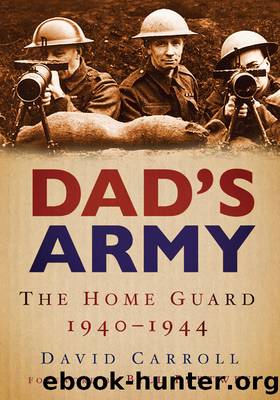
Dad's Army: The Home Guard 1940-1944 by David Carroll
Author:David Carroll [Carroll, David]
Language: eng
Format: epub
Tags: History, Non-Fiction, World War II, War & Military
ISBN: 9780752449463
Amazon: 075244946X
Goodreads: 5969307
Publisher: The History Press
Published: 2002-01-02T10:00:00+00:00
CHAPTER 5
ARMS AND THE MEN
The Home Guard training programme laid a great deal of emphasis on the handling and use of weapons. The uninspiring sight of men attending for parade or going out on duty wielding nothing more threatening than pitch-forks, broom handles and other inadequate arms was of mercifully short duration and largely confined to the early days of the LDV. Following this poor start, however, firearms flowed into the Home Guard’s armoury from across the Atlantic and also from sources closer to home. The items in question could not always be described as cutting edge or state-of-the-art, but they were welcome nevertheless. Canadian Ross and Remington rifles from America, Lee Enfields, Thompson and Browning machine guns, Vickers, Lewis and Sten guns were just a selection of the almost random assortment of firearms which eventually fell into the hands of the Home Guard. Training in the use of these weapons involved not only loading and firing, but also stripping them down and painstakingly putting them together again piece by piece. Ron Davey, for example, who was a member of the Tiverton Home Guard, recalls that he had ‘. . . to learn to dismantle and assemble blindfold’ his Browning machine gun.
As the Revd Fred Beddow of Shrewsbury suggests, weapons handling for the Home Guard novice could prove to be something of a steep learning curve. ‘We were shown how to use the Thompson machine gun but never issued with it. Instead we had the Sten. The first Stens were said to cost only 9d to make, and I believe it! They consisted entirely of roughish metal welded together and the only machined parts were the barrel and the bolt. (It showed.) But it worked, and that was what counted. Some care was needed because there was inadequate provision to disperse the heat generated by firing; also the ejection hole on the side of the barrel was unprotected and situated just where your hand would hold the gun. I suspect that I was not the only person to trap a finger in it as the bolt moved forward. It hurt but you only did it once!’
Those many members of the Home Guard who had seen service in the First World War possessed a solid foundation of knowledge and discipline which served them in good stead when it came to handling and using firearms during their Home Guard training. But it was inevitable that some less experienced members of the force, either owing to a lack of knowledge or care or because of a lapse in concentration, would occasionally run into difficulties. Frank Buckley, who served in a platoon near Oldham, explains how, during one training session when their sergeant was demonstrating the loading and unloading procedure for a .303 rifle, one of the men failed to eject all five of the cartridges before pointing his rifle upwards and pulling the trigger to check that his weapon was ready for loading again. As the men were undergoing this training in the small, dimly-lit factory which served as their headquaters, ‘.
Download
This site does not store any files on its server. We only index and link to content provided by other sites. Please contact the content providers to delete copyright contents if any and email us, we'll remove relevant links or contents immediately.
| Automotive | Engineering |
| Transportation |
Whiskies Galore by Ian Buxton(42078)
Introduction to Aircraft Design (Cambridge Aerospace Series) by John P. Fielding(33175)
Small Unmanned Fixed-wing Aircraft Design by Andrew J. Keane Andras Sobester James P. Scanlan & András Sóbester & James P. Scanlan(32835)
Craft Beer for the Homebrewer by Michael Agnew(18287)
Turbulence by E. J. Noyes(8113)
The Complete Stick Figure Physics Tutorials by Allen Sarah(7423)
The Thirst by Nesbo Jo(7002)
Kaplan MCAT General Chemistry Review by Kaplan(6989)
Bad Blood by John Carreyrou(6669)
Modelling of Convective Heat and Mass Transfer in Rotating Flows by Igor V. Shevchuk(6495)
Weapons of Math Destruction by Cathy O'Neil(6362)
Learning SQL by Alan Beaulieu(6345)
Man-made Catastrophes and Risk Information Concealment by Dmitry Chernov & Didier Sornette(6138)
Digital Minimalism by Cal Newport;(5835)
Life 3.0: Being Human in the Age of Artificial Intelligence by Tegmark Max(5618)
iGen by Jean M. Twenge(5454)
Secrets of Antigravity Propulsion: Tesla, UFOs, and Classified Aerospace Technology by Ph.D. Paul A. Laviolette(5412)
Design of Trajectory Optimization Approach for Space Maneuver Vehicle Skip Entry Problems by Runqi Chai & Al Savvaris & Antonios Tsourdos & Senchun Chai(5140)
Pale Blue Dot by Carl Sagan(5079)
